

When homeowners decide to remove a swimming pool, one of the first choices they face is whether to pursue a full or partial pool removal. While both options eliminate an unwanted pool, they differ significantly in terms of cost, long-term usability, drainage, and future property plans.
At U.S. Demo and Hauling, we believe that understanding the intricacies of full and partial pool removal can help homeowners make an informed decision that aligns with their goals, local regulations, and the future use of their property.
Partial Swimming Pool Removal
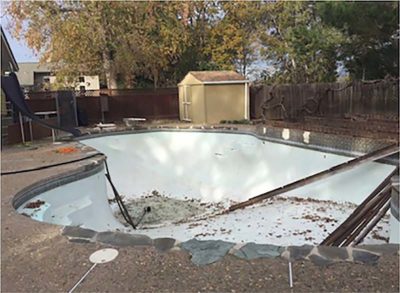
With a partial swimming pool removal, we begin with a pool demo, and the top portion of the pool’s structure is removed, anywhere from about 18 to 36 inches below grade. We then puncture the remaining shell of the pool to allow drainage, and then the hole is filled with dirt.
With an “engineered” fill, we compact the soil carefully in layers, and the entire process is inspected throughout by a licensed geotechnical engineer. With a non-engineered fill, the dirt is simply added to fill up the space with little compaction.
Typically, we recommend an engineered fill because this level of soil compaction can reduce settling issues with the soil, and it tends to ensure better drainage. The materials we use for an engineered fill are typically of higher quality as well.
A partial removal with non-engineered fill is the least expensive pool removal service, but it also has some disadvantages. In some cases, local municipalities will not allow non-engineered fill, so it may not be an option you can even consider.
Because the soil is not compacted, it will settle significantly over time. You won’t simply be able to begin landscaping the area, as the dirt can take many months to fully settle, so your yard likely will be unusable for some time after pool demolition.
Full Swimming Pool Removal
With a full pool removal project, also known as complete pool demolition, we remove the entire pool structure, including the pool walls and pool floor, as well as reinforced steel and the plumbing, gas, and electrical lines.
We can provide this service either with engineered fill or non-engineered fill, but again, there are some disadvantages to opting for the non-engineered fill, such as soil instability. Engineered fill allows you to use the area much more quickly than with a non-engineered fill.
Complete pool demolition is more expensive than partial pool removal, but it does tend to provide you with better drainage, which is especially helpful if your property features clay-heavy soil or your property was built on a hillside. Some municipalities require a complete removal, so this may be the only option you have.
This is the only option that allows you to build any structures on the area where the pool once existed. If you plan to extend your home or add an Accessory Dwelling Unit, or ADU, a full removal with engineered fill is your only option, and some cities still will not allow you to build. If you can build, you will need inspections and permits to legally add structures to the property.
Additionally, if you plan to sell your home in the near future, a complete swimming pool demolition and removal looks better to buyers because, again, the land is more stable and will incur fewer movement issues than with a partial removal.
5 Facts About Pool Removal
At U.S. Demolition and Hauling, we offer both partial and full pool removal services, but before you opt to remove this structure, it’s important to have as much information as possible, including the following facts.
- Documentation Is Crucial
You will need permits, engineering reports, inspections and possibly other types of paperwork, and it’s important that you follow your local regulations carefully. Not only do you want to avoid costly fines, but it’s simply safer to complete the project according to the law. Our team of demolition contractors can help you with the permitting and inspection process.
- You’ll Need To Disclose It
While homes in California are sold “as-is” and the buyer must accept the property’s current condition upon purchase, the seller also must disclose any known defects. Additionally, if a pool or spa existed in the backyard, this also must be disclosed, as well as the details regarding its removal. Keep copies of your permits and all documentation of the pool removal so that you can provide this information if you sell your home.
- Building New Structures May Not Be Allowed
As stated above, with any type of partial removal or even a full removal with non-engineered soil, you cannot build structures in the area where the pool existed. You might be able to build on a full pool removal with engineered fill, but it’s important to do some research about your local regulations.
- Drainage Issues Can Be A Concern
Pools alter the natural drainage patterns on your property, and this must be addressed during the removal process. Otherwise, you may end up with overly saturated soil and issues such as yard flooding during heavy rains.
Demolition companies should address this issue during removal and ensure that the soil has proper drainage and that quality fill is used and is compacted properly. Regrading may be needed, as well, to ensure that water is flowing away from your home, and we can provide this service, as well.
- Pool Removal Can Be A Smart Option
Many issues with drainage and soil settlement can be avoided by simply opting for an engineered fill and using the services of an experienced demolition contractor. While you might be concerned about the downsides, removing a pool can be a smart option for many homeowners.
For instance, if you don’t use the pool and would love to have more yard space, pool demolition makes good sense. Maintaining a pool can be expensive, as you have to pay a high price for water, electricity, and gas, if the pool and spa are heated. Repairs also can be extremely costly, and eventually you will need to upgrade equipment and resurface the pool, which is expensive.
Furthermore, your insurance costs typically go down once you remove a swimming pool from your property. If you are planning on selling your home, swimming pools can be great features, but they typically don’t add much in terms of property value. If your pool is in poor shape, but you want to sell your home soon, opting for a full removal with an engineered fill can be a more financially viable option than remodeling and repairing the pool.
While pool removal has advantages, it is crucial that you work with a demolition company that has extensive experience with pool demolition and removal. At U.S. Demo, we have been handling these projects for decades and can provide you with a demo and fill that helps you avoid drainage and severe settlement issues.
U.S. Demo – Serving The San Francisco Bay Area For 25+ Years
We can provide any type of pool removal you might need. We can remove in-ground and above-ground swimming pools. We can provide removal services for swimming pools constructed from any materials, including concrete, fiberglass, and pools with vinyl liners, as well as spa or Jacuzzi removal.
In addition to swimming pool removal, we also can provide you with many other demolition services, including concrete demolition, building demolition, driveway removal, debris removal, and much more. Whether you need pool removal or another of our services, contact us at any time to discuss your project, and we can provide you with a free cost estimate for our services.